Category Archives: Scriptural Thought for the Month

The Book of Judges: Leadership Needed, Apply Here! Judges 19

‘In those days, when there was no king in Israel, a certain Levite was sojourning in the remote parts of the hill country of Ephraim, who took to himself a concubine from Bethlehem in Judah’ (Judges 19:1).

When my brother had trained for the ministry and was looking for a church, he worked at Co-op depot in Preston. He’d been witnessing to one of the lorry drivers, so he gave him a Bible. By the time the man had reached the end of Genesis, he was shocked by some of what he had read. The danger is we can be so familiar with the Bible we forget how shocking it can be! But be warned! What comes next in Judges registers as some of the most shocking incidents in scripture!

 At was start of chapter 19, we’re introduced to another wandering Levite. That should raise eyebrows as the Levites were required to do certain jobs connected with religious worship. But we then get the now familiar words: ‘In those days, when there was no king in Israel’ (v1). So the picture is that, even early in their history, Israel was in a bad way and lacking leadership. This kicks off a disturbing story that will take us to the end of the book!Verse 1 is supposed to make us feel uneasy. The best definition of: ‘a concubine’ would be a second class wife! She wouldn’t have the full rights of a married woman and children from such a union wouldn’t have any inheritance. So, to misquote Shakespeare’s Hamlet ‘there is something rotten in the state of Israel.’ Our unease increases when the text informs us that she’s unfaithful to him (how is not specified). Four months pass and he decides it’s time for a reconciliation. So he goes to her father’s house to reclaim her and the whole event seems to turn into a party lasting a few days! The conclusion, this Levite seems to have a lot of time on his hands for someone with a specified job to do (vs2-9).

If these events illustrate a breakdown in what God intended for the family, what happens next illustrates a breakdown in society. After deciding not to stay at Jebus (eventually to become known as Jerusalem) the man decides to stay among his kin in Gibeah. Waiting in the town square might seem strange, but that was where you would have gone if you were looking for hospitality as in Arab culture, then and now, to refuse hospitality would be unthinkable! Once again, there should be a feeling of unease when none is forthcoming but it’s an old man, not originally local to the area, who offers them hospitality (vs10-21).

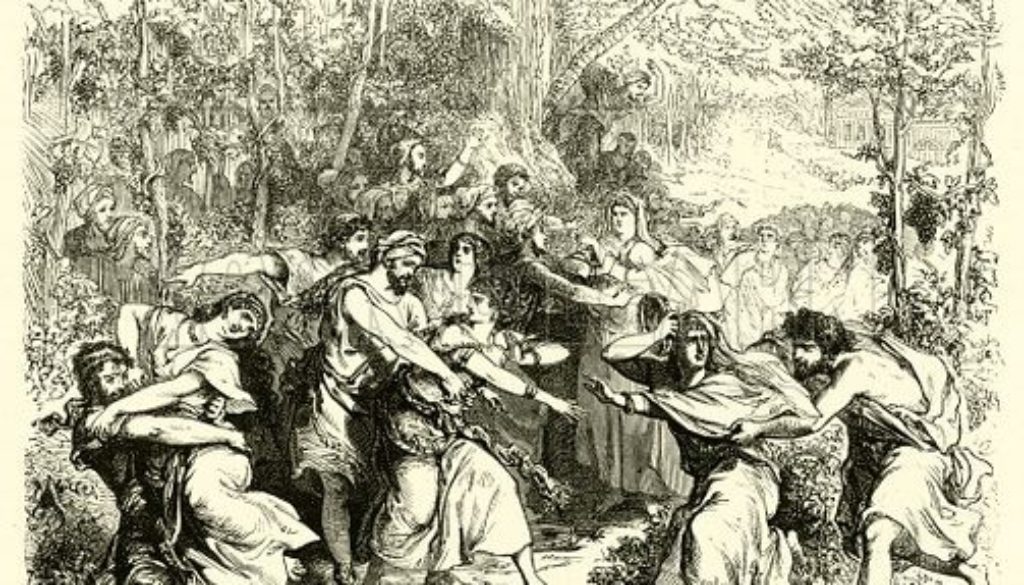
But if all this wasn’t bad enough, we now get a complete breakdown in morality. What happens next (vs22-26) reminds us of events of Genesis 19 when God deemed the cities of Sodom and Gomorrah  to be so wicked that they were fit for judgement. But we should be doubly shocked as this is among God’s people! There’s an ambiguity in the way that the old man reacts to the threat of homosexual rape being committed on his guest as he protests: “No, my brothers, do not act so wickedly; since this man has come into my house, do not do this vile thing” (v23). So, what would happen if the Levite wasn’t his guest? It also gives the impression that this wasn’t an uncommon occurrence! The Levite reaction is also ambiguous as he does nothing when the old man offers his young daughter to be abused and violated. Then he shows no hesitation in forcing his concubine to go out to the mob to be violently abused for hours!

Now let’s think about this. A Levite is someone who’s supposed to be acquainted with the law and spend his time teaching it, not someone who acts in a thoroughly callous and immoral way. It’s a sad thing when Christian leaders don’t set a moral example, but sadly it’s nothing new!

The Levite’s wicked and callous behavior continues as he: ‘rose up in the morning’ and we realized that he had slept through the whole thing! His disgraceful behavior continues when he’s surprised when he gets no answer from his dead concubine after she’s been exposed to a vicious gang rape, but puts her on his donkey and goes home (vs27-28).

When we think it couldn’t get any worse we get a breakdown in leadership! The Levite’s grizzly delivery of body parts to the twelve tribes not surprisingly gets a reaction (v29). When a disturbing murder been committed, analysts theorize why it’s happened. Was it the perpetrators background, a disturbing influence in the home or peer pressure? We see the same kind of thing here with everyone trying to analyze what’s happened.  ‘And all who saw it said, “Such a thing has never happened or been seen from the day that the people of Israel came up out of the land of Egypt until this day; consider it, take counsel, and speak” (v30). Quite rightly, everyone’s terribly shocked. But, rather than look to the Lord, Israel is basically saying “if anyone can help us understand this, tell us what to do?” No one’s prepared to take charge. It’s really a case of ‘leadership needed, apply here!’

The Book of Judges: Living Outside the Law of the Lord! Judges 18

‘In those days there was no king in Israel. And in those days the tribe of the people of Dan was seeking for itself an inheritance to dwell in, for until then no inheritance among the tribes of Israel had fallen to them’ (Judges 18:1).

If repetition is a great help when it comes to learning, I don’t think you’d get too much of an argument from the writer of the book of Judges as that’s the technique he applies. In verse 1 of chapter 18 he reminds us that there’s no king, highlighting that the people of Israel are doing their own thing. That being the case, we are now introduced to the Danites who are wandering about and looking for a place to settle down.

However, this should strike us as all wrong. Hadn’t they been granted an inheritance back in the days of Joshua? The answer is yes, but in Judges 1:34 the text tells us that when they went to claim it, the Amorites put up stiff resistance and the Danites had given up on it as a ‘bad job’! So here they are, a few years later (the historical setting being early in the book’s narrative), and they’re still looking for somewhere to settle! Unfortunately, this introduction to the Danites also introduces us to their considerable failings, one of which is covetousness, as they are seeking to take another tribes land by force. So, once again, this demonstrates failure on the part of God’s people.One night five Danites turn up at Micah’s residence. While they’re staying there, they recognise the Levite’s voice. Not unreasonably they ask him what he’s doing there and he gives the explanation that he’s got a cushy job as a priest. So, they ask him to inquire of the Lord for them, will their journey to seek for a place to settle be successful? The priest pretty much tells them what they’d like to hear: “Go in peace. The journey on which you go is under the eye of the Lord” (v6). But, once again, everything about this is wrong as they had already been granted an inheritance, but they had failed to take it (vs1-6)!

Encouraged by this news, however dubious, the Danites continue on their way until they come to Laish. Figuring the people that have a good life and, more to the point, are isolated, they report to their fellow kinsmen that the town is an easy target (vs7-10). Having a contingent to 600 men and no doubt buoyed up by the priest’s Danite pleasing message, they figure that a bit of looting and kidnapping will be overlooked by the Almighty or, who knows, even approved of! When the priest asks them what they’re doing, after telling him to keep quiet, they make him an offer that they reckon he won’t refuse. “Come with us and be to us a father and a priest. Is it better for you to be priest to the house of one man, or to be priest to a tribe and clan in Israel?” (v19). The Levite, probably thinking that career advancement had never come so easily, helps them with some looting and makes his escape with them (vs11-20).

The Danites are a long way down the road before Micah, his family and his servants catch up with them. Not surprisingly, Micah’s somewhat put out, but what he says next shows the pathetic nature of his religion! ‘And he said, “You take my gods that I made and the priest, and go away, and what have I left? How then do you ask me, ‘What is the matter with you?’” (v24). Here we have a man who is centring his whole life around what he has created! However, the Danites show they can be just as pathetic, not just in hanging on to the idols, but by being prepared to fight for them! Being outnumbered, Micah decides to call it a day. When it comes down to it, Micah’s theology wasn’t worth standing up for, and the Danites theology  just consisted of idolatry, insulting language and threats! But what are we to expect when people depart from God’s Law (vs21-26)?

The passage ends with the Danites attacking the unexpecting people of Laish and massacring them. The Danites don’t seem to show any sense of regret over the action they have taken as they rebuild the city, calling it Dan, and setting up ‘the carved image for themselves’ (v30). The Levite’s name is revealed to be Jonathan and he and his sons act as priests acting as rival to the worship at the Tabernacle in Shiloh.

Yet, whereas, often the writers of historical texts in the Bible seemed to offer no judgement (although  we should always read these passages with a mind to what God has ordained through his law) here there is an indication of the writer’s stance. His comments in verses 27 and 29 register strong disapproval. ‘And they named the city Dan, after the name of Dan their ancestor, who was born to Israel; but the name of the city was Laish at the first’ (v29).

As these incidents follow on from the events of chapter 17, the writer continues to pose his question, even adding do it. If, when false religion is introduced into a society, it can affect the structure of the home and the family, what does it do to society as a whole if people continue to pursue it?

The Book of Judges: Setting the Scene: Judges 17

‘And the man Micah had a shrine, and he made an ephod and household gods, and ordained one of his sons, who became his priest. In those days there was no king in Israel. Everyone did what was right in his own eyes’ (Judges 17:5-6).

The closing chapters of the book of Judges (chapters 17-21) could pose a problem that would lead to us scratch our heads in disbelief. What are we to make of them as they don’t seem to follow the pattern of the book, but seem to go off at a tangent? If  1:1-3:6 acted as a historical introduction and  3: 7 -16:31, gave us the case histories of various Judges that the Lord raised up to save his people (with the exception of Abimelech), what are we to make of the final chapters of the book?

Perhaps the best way to think of these chapters is to think of the writer of the book as a bit like a correspondent who’s in the middle of a war zone. They can report on various battles, but they can’t be everywhere at once. So, you get are reports of various incidents that act as  examples of what is happening overall. It’s not the whole picture, but it gives you a good idea of what’s going on.

Every indication is that the events of chapter 17 happened quite early in the history of the book as Phineas (20:28) is the high priest during the time that is covered in these last chapters. He dates from Moses time where he is commended for his zeal for the Lord (Numbers 23:10-13).

But despite this, the opening of the passage might strike us as downright peculiar (vs1-3). We are introduced to Micah who lived in: ‘hill country of Ephraim’ (v1) and who had stolen a considerable amount of money from his mother. However, he very quickly returns it, not because he’s suffering  pangs of conscience, but because he hears his mother uttering a curse concerning it. The peculiarity of the passage really kicks in with his mother’s reply when he returns the money. ‘And his mother said, “Blessed be my son by the Lord” (v2). This is pretty indulgent, and lacking in the discipline his action should’ve demand. But, if the mother’s next words  “I dedicate the silver to the Lord” (v3) seem a bit more encouraging, that rapidly dissipates due to the fact that she doesn’t dedicate all the money, but only a small part of it, and that’s used to make an idol! This  action  breaks a good number of the Ten Commandments. But Micah’s happy to goes along with this and adds it to his collection of idols! He then installs one of his own sons as a priest, showing a major disregard for the law! The text gives a very succinct summing up of these events with the words: ‘In those days there was no king in Israel. Everyone did what was right in his own eyes’ (v6). The writer’s intention in verses 1-6 is very clear, this incident shows that Israel is in a mess, because there are spiritual failings, which inevitably lead to moral failings in the home and family which, being the bedrock of the society, spells big trouble for the nation as a whole!

Next we are introduced to the wandering Levite from Bethlehem (vs7-8). Once again, this should set alarm bells off as there’s so much wrong with this. Firstly, Bethlehem was not one of the towns set aside for the Levites. Secondly, the Levites had jobs connected with the Tabernacle and with the teaching of the Law. And finally, they were supposed to be supported by the people so they could get on with the Lord’s work. But here we have a Levite for hire! He’s not where he should be with time on his hands, wandering around and looking for a place to stay! Let’s face it, this tells us that Israel has fallen into a sorry spiritual state!

However, Micah thinks it will give his shrine added credibility to have a genuine Levite as a priest rather than his son, who should never have been a priest in the first place. The Levite obviously thinks that: ‘ten pieces of silver’ plus clothing (no doubt a priestly garment) and food and lodging sounds a pretty good deal (v10). With his son given the boot as priest and the Levite installed as his new priest, Micah reflects: “Now I know that the Lord will prosper me, because I have a Levite as priest” (v13), happily fooling himself that his false religion will bring him greater prosperity!

The writers intention in this chapter is to show us the low moral and spiritual temperature of the nation. This will prepare us for what we now encounter as we read these last chapters of the book. But it could be argued the writer  is posing a question to prepare us for what will follow. The question is the following, if this is what happens when people get spiritually creative in their worship and ignore what the Lord has commanded, what kind of effect does it have on the nation and God’s people as a whole? The chapters that follow will answer the question!

The Book of Judges: Samson Part 5: Personal or Sacrificial? Judges 16:23-31

Then Samson called to the Lord and said, “O Lord God, please remember me and please strengthen me only this once, O God, that I may be avenged on the Philistines for my two eyes” (Judges 16:28).

If we’ve learned anything about Samson, it’s he always thought he could get himself out of trouble. There’s some debate over how we understand his strength, but I think the text suggests he was naturally strong, but was given exceptional strength when the: ‘Spirit of the Lord’ came upon him. But perhaps that’s part of his problem, he depended too much on his natural gifts and played fast and loose with the Lord’s blessing, always depending on the visible part of the Nazirite vow, his hair, as proof God was with him!

Hollywood excels in films where there’s some form of redemption. A flawed character may commit a sacrificial act, towards the end of a film that makes us want to forgive anything of a dubious nature they’ve done. So, when we come to this point in Samson’s story, many commentators are looking for some form of redemption. But can we actually find it?Verses 23-24 point to the folly of the ungodly. Back in verse 20 we read that the: ‘He (Samson) did not know that the Lord had left him.’ But the Philistines make a tremendous mistake because they believe: ‘Our god has given Samson our enemy into our hand’ (v24). Their second mistake is they didn’t realize Samson was an instrument of the Lord, who was using him to punish the Philistines for their oppression of his people. So, in their mind’s, it’s obviously a time for celebration and, while they’re thinking about it, wouldn’t it be a good idea to have Samson, who they see as blinded and harmless, come out and entertain them (v25)!

But the way this temple was constructed gave Samson an opportunity. Excavations in the Near East have showed that the supports of these temples would have been huge wooden pillars which were on a stone base, but were held in place by the weight of the roof. Samson, on his trips to Gaza, may have noticed this. Under the guise of wanting some rest, he asks the young man leading him to place his hands on these pillars (v25-28). No doubt, Samson had had plenty of time to think about his Nazirite vow. So what happens next suggests that he’s realized his long hair is not the source of his strength, but the outward sign of God’s blessing and this is what now shapes the prayer he now prays.

But what he prays needs to be carefully analyzed. Is this a prayer of faith, that seeks to do the Lord’s will, and glorify him? Or is it possible, that this prayer has elements which relate to Samson’s condition and a thirst for revenge?

Samson had prayed to the Lord before (15:18). But as that was after the: ‘Spirit of the Lord’ had come upon him, you  get the impression they’re prayed in the spirit of ‘I’ve done your work, so you now owe me.’ But this prayer is before he does anything. So, this is a much more positive spiritual attitude than we’ve seen from him before. So let’s look at the content of his prayer.

Samson uses two names for the Lord here. But the first, and most important use is ‘Yahweh,’ as he addresses him as: ‘LORD God’ (v28). This suggests that for the first time Samson is actually acknowledging that the Lord has been working through him and it’s the Lord who has authority over him, whereas up to this point, Samson has seemed to do his own thing!

But, as soon as he’s done that, it’s payback time! Samson seeks revenge for being blinded. So, the question is, have we gone from an acknowledgment that he has been used and guided by God in the past, whether he realized it or not, to good old fashioned revenge on the level of any Hollywood action movie with the tag line ‘This time it’s personal!’ Yet, at the same time, his action takes on a sacrificial act with his words: ‘let me die with the Philistines’ (v30) as he wins a huge victory for Israel by practically taken out the Philistine high command in one go!

The story comes to an end with his family coming and taking the his body for burial with no resistance, which is not surprising after the defeat the Philistines have just suffered. We are reminded that: ‘He judged Israel for 20 years’ (v31). But, and it’s a big but, Samson leaves us with many questions  when it comes to trying to evaluate him.

On one hand we have someone who’s birth was foretold, who was dedicated to the Lord and gifted in a most unique way. He carries out the Lord’s purposes and his life ends in an almost a sacrificial act. Yet, most of the time he’s a loner, and the maverick Judge of Israel! He begins the deliverance of Israel, but it’s the Lord who will finish it! Some commentators have labelled Samson  a ‘type’ Of Christ’. I would say that he’s more of an impression of the work of Christ, as there are interesting parallels.

Dale Ralph Davis tells the story of how a delegation went to President Abraham Lincoln during the American Civil War calling for the sacking of General Ulysses Grant, who, reportedly, had been drunk at the battle of Shiloh. Apparently, Lincoln sat in silence for a long time. Eventually, he said: “I can’t spare this man; he fights.”[1] Perhaps that’s the best way to sum Samson up. Put him with Israel’s (and therefore God’s) enemies and there’s bound to be fireworks. We may not always understand how God’s sovereignty works, but we can take immense comfort from the fact it does!

[1] Dale Ralph Davis, Judges, Such a Great Salvation (Fearn, Christian Focus, 2000) 193.

The Book of Judges: Samson Part 4: How the Mighty have Fallen: Judges 16:1-22

‘After this he (Samson) loved a woman in the Valley of Sorek, whose name was Delilah. And the lords of the Philistines came up to her and said to her, “Seduce him, and see where his great strength lies, and by what means we may overpower him, that we may bind him to humble him. And we will each give you 1,100 pieces of silver” (Judges 16:4-5).

I’m a great fan of the Greek myths. In story of a Odysseus,  as he and his men row past the island where the Sirens reside, he has himself tied to the mast and his men, who are rowing, put bee’s wax in their ears so they will not hear the song of the Sirens and be lured to their deaths. However, Samson seems oblivious to taking precautions. He’s been given immense advantages, and yet he continues to do his own thing, despite the Lord’s deliverance at the end of chapter 15!

In verse 1 of chapter 16, we once again we find him in the wrong place and in the wrong company! You wouldn’t believe it, as this is hardly worthy of the Lord’s servant,  but here it is in scripture! A visit to a prostitute, in Philistine territory, puts him at risk. The text is reminiscent of chapter 14 verse 1. Once again Samson sees a pretty face and is ruled by his passions. In the end, he uses his immense strength to get him out of trouble (v3), but the way he does it shows he treats the whole thing like an immense joke!So why is this story here, as it doesn’t seem to fit naturally with the rest of the narrative? The reason is to alert us that Samson is still driven by his instincts, doing his own thing and he hasn’t learned a thing from his past misdemeanors. In other words, it’s setting him up for a fall! You might think he’d say to himself after this incident “I’ve been in trouble when I gone after Philistine women before. I lost a bet, and the other times I could have been killed, so these situations are best avoided.” But alas, he doesn’t.

So in verse 4 we read: ‘After this he loved a woman in the Valley of Sorek, whose name was Delilah.’ The name has religious connotations, but whether she was involved directly in serving in the worship of the Philistine god Dagon we don’t know. But we do know she wasn’t an Israelite, she was a Philistine who were enemies of God’s people. The Philistines leaders know Samson far better than he knows himself. Knowing he can’t resist a pretty face, they go to Delilah with money, which she happily accepts, to get her to find out the secret of Samson’s great strength (v5).

The trouble with Samson is that he’s so confident in his strength, he treats her question, like a game (vs6-14). No doubt Delilah introduced it by means of pillow talk. She may even have been laughing the first few times she said: “Behold, you have mocked me and told me lies” (v10). But she skillfully plays Samson, eventually pulling out the big guns with the words: “How can you say, ‘I love you’, when your heart is not with me? You have mocked me these three times, and you have not told me where your great strength lies” (v15). She nags him, which hardly spices up in the relationship, but wears him down so he eventually confesses the secret of his strength (v17). To cut a long story short, while he’s unaware, Delilah gives him a haircut. Once again, Samson thinks he can do it all by himself, but this time he pays the price. I think we are meant to feel a sense of tragedy in verse 20. ‘And she said, “The Philistines are upon you, Samson!” ‘And he awoke from his sleep and said, “I will go out as at other times and shake myself free.” But he did not know that the Lord had left him.’ The result is he’s captured, blinded and put to menial and degrading work (v21)!

But this reminds us that Samson just doesn’t learn. Hadn’t this same tactic been employed before by his Philistine wife and lost him a bet (14:15-17)? Mistakes can be of some value, when we learn from them. But Samson seems incapable of doing that! Samson, as usual, is driven by his appetites, and what probably mattered most to him here was Delilah’s nagging was cutting down on his carnal pleasure!

But it also shows something else, his flippancy towards the gifts the Lord had given him. Not just that, he was someone who would rather fellowship with the Lord’s enemies than the Lord’s people. I can’t help thinking that maybe Solomon had Samson in mind when he wrote: ‘Do not desire her beauty in your heart, and do not let her capture you with her eyelashes; for the price of a prostitute is only a loaf of bread, but a married woman hunts down a precious life’ (Proverbs 6:25-26). Delilah wasn’t a prostitute, but Samson had prostituted himself in regards to his service to the Lord!

In the end, Samson is an example of the worst kind of religion, one that puts its faith in religiosity. For Samson it was his long hair, the only part of his Nazarite vow he seemed to have kept! His delusional faith was dependent purely on religious practice rather than real faith. For some it might be church attendance or taking communion regularly. In the end Samson seems to have had no great faith and rather takes the Lords promises for granted. As such, he acts as a warning to those who would put their faith in religious practice rather than faith in the Lord!

The Book of Judges: Samson Part 3: Tip for Tat! Judges 15

‘And God split open the hollow place that is at Lehi, and water came out from it. And when he (Samson) drank, his spirit returned, and he revived. Therefore the name of it was called En-hakkore; it is at Lehi to this day.’ (Judges 15:19).

There’s a saying, ‘they don’t make them like they used to.’ That phrase could be applied to the action movies of the 80s with their larger than life characters which were usually played by someone like Arnold Schwarzenegger or Sylvester Stallone. The plots were simple, the hero was seriously wronged, or someone in their family was kidnapped or threatened. The hero would then go on the rampage destroying the equivalent of a small country to get justice!I can’t help thinking that Samson almost falls into that category. We’ve already seen that he’s a maverick, he does his own thing and he doesn’t seem too worried about the consequences! So, how do we evaluate Samson in his role as a judge and therefore God’s servant?

But whatever we think about Samson, he’s not holding a grudge. The wedding may not have gone to plan, but Samson turns up on his father in law’s doorstep with a goat in lieu of flowers. He’s probably thinking, their make a fresh start, they’ll have a bit of a BBQ and consummate the marriage like nothing’s ever happened (v1). But his father-in-law informs him that his wife is now married his best man, and anyway, isn’t her younger sister better looking (v2)?

Once again, Samson’s character can be summed up in a sentence. ‘And Samson said to them, “This time I shall be innocent in regard to the Philistines, when I do them harm” (v3). At the best, this could be seen as an admission that the Philistines didn’t quite merit the treatment he dished out on them last time (14:19). But it also illustrates Samson’s character. Let’s contrast it with another action hero from the Bible. David’s first words in scripture are concerned for the Lord’s honour (Samuel 17:26). Samson’s words here are concerned with avenging some hurt he somehow feels that the Philistines have inflicted on him!

Samson’s revenge is both ingenious, and incredibly cruel where the foxes are concerned (vs64-5). Not surprisingly the burning of their crops annoys the Philistines greatly. This action proves, once again, that Samson acts impulsively and doesn’t think things through as he may have got his revenge, but his would be wife and her family die for it (v6)! After another confrontation with the Philistines Samson retreats (vs7-8).

But now there’s a major problem as the men of Judah now find themselves on the end of Philistine aggression. Finding out Samson is responsible, 3000 men  go to find him. That made me wonder if they weren’t sure what kind of mood they’d find him in, testifying to his volatile nature. However, they find Samson in, what for him, is a more reflective mood. Asked why he started all this trouble, his answer again shows his impulsive childish nature as he more or less says well it’s just a case of tip for tat’ (v9-11). After a promise that they won’t kill him, but just hand him over to the Philistines, Samson agrees to go with them (vs12-13). But it’s a sad situation as, whatever we think of Samson, he is the one who is to start the deliverance of the Lord’s people (13:5) and here are the Lord’s people collaborating with the enemy!

However, the Philistines completely misjudged the situation. They may be excited at the sight of their enemy being delivered to them securely tied up, but they’ve left the Lord out of the equation! It’s notable that their last tussle with Samson (v8) did not involve the Spirit of the Lord coming upon him. But now they’re in for an unpleasant surprise as the ‘Spirit of the Lord rushed upon him and the ropes that are on his arms became as flax that has caught fire and his bonds melted off his hands’ (v14).

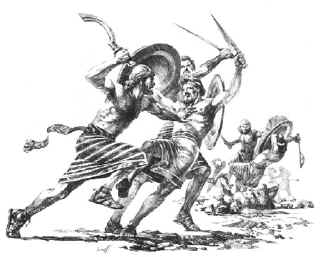
What happens next demonstrates that although Samson may have had an impressive physique, we get demonstrations of his exceptional strength when the Spirit of the Lord hasn’t come upon him elsewhere, but when it does the results are exceptional! Like the best action heroes Samson improvises, by using the jawbone of a donkey that’s lying around. A 1000 Philistines bite the dust, and, again, like the best action heroes, Samson has a nifty one liner: “With the jawbone of a donkey, heaps upon heaps, with the jawbone of a donkey have I struck down a thousand men” (v16). A very literal translation, has a humorous touch to it as this is pretty much a pun when it’s translated. ‘With the jawbone of ass I have piled them in a mass.’ The place is named in honour of the event reminding us this is history (v17).

Samson’s spiritual journey seems to have been a long and difficult one. He acknowledges that he is the Lord’s servant, despite having followed his own desires most of the time. But there’s a sense in verse 16 of him almost saying “I’ve done the first bit for you Lord, now you’ve got to help me out” which the Lord very graciously does.

The passage seems to end on a rather odd note where Samson is concerned. ‘And he (Samson) judged Israel in the days of the Philistines for twenty years’ (v20). This might cause us to think, hold on a minute we haven’t got to the well-known part of Samson’s story yet. But I think the writer might be making a sly point here. We are yet to meet the Samson that is listed among the ‘Heroes of faith’ in Hebrews 11:32 as that is yet to come!

The Book of Judges: Samson: Part 2: The Maverick Judge! Judges 14

 ‘Samson went down to Timnah, and at Timnah he saw one of the daughters of the Philistines. Then he came up and told his father and mother, “I saw one of the daughters of the Philistines at Timnah. Now get her for me as my wife” (Judges 14:1-2).

I remember reading a review for the first ‘Pirates of the Caribbean’ film ‘The Curse of the Black Pearl.’ One line stood out. ‘From the moment Johnny Depp opens his mouth, you know you’re in for a rollicking good time.’ When I saw the movie I understood exactly what the reviewer meant as when we meet Captain Jack Sparrow and hear him speak for the first time, we realised the film’s going to be a lot of fun! Such is the case with Samson, as his first words give us a fair indication of what to expect from him.

Indeed, even before that, we get an indication this is a man who lives for the moment. The phrase: ‘Samson went down’ (v1) is supposed to make us question whether he’s where he should be. But when he opens his mouth he confirms he’s been among the Philistines and not God’s people. Even his parents showed concern, evidently thinking about the Law (Deuteronomy 7:3) where the Lord forbids marriage with such people. So they ask him why he can’t find a wife among his own people? But Samson’s appetite is such he ignores his godly parents. He ‘sees’ and then he ‘wants’ and nothing’s going to get in the way of that as he’s at the mercy of his hormones! This is made clear in verse 7 where he: ‘went down’ again and talks to the woman for the first time! He may have been prepared from birth to be God’s Judge, but he certainly doesn’t act like it! Indeed, he seems to be tied up in Israel’s spiritual malaise, as he’s fraternising with the enemy! Yet, despite this, verse 4 tell us: ‘that it was from the Lord, for he was seeking an opportunity against the Philistines.’

But Samson isn’t without brains, and in verses 5-14 we have a series of events which he thinks gives him the opportunity to defer the cost of the wedding. However, this is not without problems when it comes to his Nazarite vow. Firstly, we have his tussle a lion. The Hebrew is very clear that this was a young lion in its prime, but it was no match for Samson when: ‘the Spirit of the LORD rushed upon him’ (v6).  This leads to contact with the dead body when he takes honey from the carcass, the fact he doesn’t tell his father and mother where the honey came from, suggests they wouldn’t have approved! And finally it’s quite clear from the Hebrew that the party Samson is involved in is a drinking party, and alcohol was a definite no no in relation to the Nazarite vow! But it’s at this point that Samson challenges the Philistines with a riddle that he’s convinced will have the Philistines stumped and save him the cost of his wedding.

But whatever the ingenious nature of the riddle, Samson has forgotten who he’s fraternising with by wanting to take a Philistine wife, and that means he’s compromised. His Philistine hosts don’t like the idea of losing this bet and put pressure on his wife by threatening to burn the family house down. She turns on the waterworks and this being the fourth day with the marriage due to be consummated on the seventh, Samson sees the honeymoon going down the drain and, from what we know of Samson so far, there’s no way he’s going to let that happen! Now armed with the knowledge they need, his Philistine hosts present him with the answer to the riddle, much to his annoyance!

It shouldn’t surprise us, but Samson turns out to be a bad loser. Once again we get an insight into his character with his rather crude comment: “If you had not ploughed with my heifer, you would not have found out my riddle” (v18) as he seems to infer some indecency between his wife to be and his Philistine hosts. However, for the second time: ‘the Spirit of the LORD rushed upon him’ (v19) and he’s able to pay for his bet by killing and taking the garments of thirty Philistines  from the town of Ashkelon. In the end he doesn’t get the girl, as he goes off in a sulk to his parent’s home.

So how do we sum up this disappointing episode in terms of Samson’s behaviour? Firstly, Samson seems to work alone, and I can’t help but think that’s a weakness. The other Judges gathered people round them when they were raised up to deliver Israel. But Samson’s a loner, with accountability to  no one. He may be used by the Lord, but most of the time, we get the impression that he does what he wants, where he wants and when he wants to do it, and no one’s going to get in the way of that!

So, is there any encouragement we can take from this passage? The encouragement is that the Lord, in his providence, brings about his purposes for his people. This is not an excuse to behave however we want. That’s  not what we should take from this chapter. But it’s a huge encouragement when we consider our weaknesses, and wonder if the Lord could ever use us at all! The answer is, he can and he does! But, at the same time, Samson’s example in this passage is definitely not the one we should be following. Rather, it should act as a warning!

The Book of Judges: Samson: Part 1: God Makes a Judge! Judges 13

“For behold, you shall conceive and bear a son. No razor shall come upon his head, for the child shall be a Nazirite to God from the womb, and he shall begin to save Israel from the hand of the Philistines” (Judges 13:5).

Back in the golden age of Hollywood, David Niven, an English actor seeking fame and fortune, shared a house with the famous film star Errol Flynn. Concerning his friendship with the Errol he made this comment. “You can always depend on Errol to let you down.”

Now that’s a pretty good summing up of Israel in the book of Judges. At the start of chapter 13 they have once again rejected the Lord. Yet there are two differences. The first is the Philistines are making their first major appearance on the pages of scripture! The second is there’s a glaring omission. We don’t get the usual crying out to the Lord! There seems to be an overlap between the start of 1 Samuel and this time. So it’s possible that these events take place after the events of 1 Samuel 4 and the battle of Aphek where Israel’s totally defeated and the Ark of the Covenant is captured. So the attitude seems to be, if you’re going to be oppressed, you could do worse than the Philistines!

Samson’s origins are as unlikely as one could imagine. Manoah and his wife are childless because she is: ‘barren’(v2). Children were seen as a blessing from God, so the lack of them would have raise eyebrows, as people might have wondered if there was some unconfessed sin in the couple’s life. Coupled with this they were Danites, a small tribe that due to certain sins would soon disappear from the pages of scripture. Yet these are the people that the Lord selects to be the parents of Israel’s deliver!

The way the message is delivered is rather strange. Manoah’s wife has an encounter with the Angel of Lord, which is generally a reference to the pre-incarnate Christ! Yet when she tells her husband about it she seems a bit uncertain. To paraphrase, she says: “guess what happened to me today, I met someone who could have been an Angel as he was pretty impressive, and I’ve been told I’m going to have a child, not just any child, but an exceptional one!” (vs3-7). What’s particularly interesting is the inclusion of the Nazarite vow (Numbers 6). This was something that people generally took for a short period of time, but here it is appointed from birth as: “the child shall be a Nazirite to God from the womb to the day of his death” (v7).

But what comes across very clearly is that this is a godly couple. From later events, it’s quite obvious that Manoah originally thought they were dealing with a prophet who was bringing a message from the Lord to them. But in verse 8 he does the right thing by praying to the Lord about how it would be best to bring up this child. The prayer is promptly answered as the Angel of the Lord appears again, this time to Manoah and his wife. Manoah displays faith by asking: “Now when your words come true, what is to be the child’s manner of life, and what is his mission?” (v12). The point is that they’re expecting God to work even their not fully aware of who they are dealing with (v16)!

After offering hospitality, which is rejected in favour of a sacrifice (vs15-16), Manoah asks: “What is your name, so that, when your words come true, we may honour you?”  He gets the reply: “Why do you ask my name, seeing it is wonderful?” (vs17-19). When the sacrifice is made, It becomes apparent this really is the Angel of the Lord. Manoah is terrified realising what the Lord had said to Moses, that if he sees God face to face he will die (Exodus 33:20). However, his wife has her wits about her as, although she’s probably terrified, she realises that if God  intended to kill them, he would not have accepted their sacrifice (vs20-23).

The Word of the Lord is fulfilled. Manoah’s wife gives birth to a son who they named Samson. It is noted that while he’s growing up: ‘the LORD blessed him’ (v24). The chapter concludes: And the Spirit of the Lord began to stir him in Mahaneh-dan, between Zorah and Eshtaol’ (v25). This makes us think about what was said earlier. Samson is the Lord’s instrument and is being equipped for a task as he:  ‘shall begin to save Israel from the hand of the Philistines’ (v5). This time the Lord is not just going to raise up a deliverer, he’s made one!

The Book of Judges: Jephthah Part 3. Final Days and Aftermath: Judges 12

‘The men of Ephraim were called to arms, and they crossed to Zaphon and said to Jephthah, “Why did you cross over to fight against the Ammonites and did not call us to go with you? We will burn your house over you with fire.” And Jephthah said to them, “I and my people had a great dispute with the Ammonites, and when I called you, you did not save me from their hand” (Judges 12:1-2).

Despite the disadvantages he had grown up with, Jephthah has proved when Israel needed a: ‘mighty warrior’ he had all the right credentials, although he also proved to be handy as a diplomat as well. Despite his needless vow which led to tragedy for his daughter and himself, he’s proved to be the man who God raised up to deliver Israel. But his story is not yet over.

There’s a famous quote in the novel ‘The Go-Between’ by L. P. Hartley. ‘The past is a foreign country, they do things differently there.’ It acts as a reminder that we can be so obsessed with the present, that we don’t look back at the past and learn from it. When we get to this part of Jephthah’s story, I can’t help thinking that he would have benefited by looking back at past history.

We’ve encountered the Ephraimites before in Judges. In their encounter with Gideon they came across as stroppy and undiplomatic. But Gideon showed tact and diplomacy when handling them (Judges 8:1-3). Unfortunately the Ephraimites manners haven’t improved since that time as when they encounter Jephthah they accuse him of not calling on them during the battle and threatened to burn his house down (v1). It could be argued that Jephthah is provoked, but rather than taking Gideon’s example, he reacts angrily. He reminds them that they didn’t come to his aid, but the Lord gave him victory (vs2-3). The sad thing is it’s possible this was a misunderstanding. Under the oppression of the Ammonites, it could have been a case of every man for himself and could’ve led to the Ephraimites not being called upon. But Jephthah’s diplomatic touch has deserted him and if the Ephraimites are cruising for a bruising he’s only to happy to oblige!

The tragedy is this is one generation on from Abimelech’s disastrous rule and Jephthah is leading Israel down the same path again! Once again, we get a taste of his doggy theology.  He knows of the Covenant, but he makes this personal which is demonstrated in the phrase: ‘Why then have you come up to me this day to fight against me?’ (v3). The Ephraimites attitude is actually an offence against the Lord, but you’d never know it by Jephthah’s attitude. The upshot of this is civil war, and we are forced to ask whether things are any better than it was in Abimelech’s time!

Jephthah and his men not only win the battle, they: ‘capture the fords of the Jordan’ (vs 4-5). What then follows, if it wasn’t in the Bible, you’d think it was from a ‘Monty Python’ sketch. ‘And when any of the fugitives of Ephraim said, “Let me go over”, the men of Gilead said to him, “Are you an Ephraimite?” When he said, “No”, they said to him, “Then say Shibboleth”, and he said, “Sibboleth”, for he could not pronounce it right. Then they seized him and slaughtered him at the fords of the Jordan. At that time 42,000 of the Ephraimites fell’ (v6). It would be funny if it wasn’t so sad as Jephthah’s test of regional dialects proves how divided Israel is! Just as Israel needed a saviour after Abimelech’s, disastrous rule, it desperately needs one again! In the end we’re left with Jephthah’s rather sad epitaph (v7) with no mention of his liberation of Israel!

Verses 8-15 cover a period of 25 years. But 25 years of what? Ibzan with his huge number of sons and daughters, who he marries off, may have been trying to build influence through political alliances. Elon was a Judge for 10 years, but we know nothing about him! Abdon Seems to be a throwback to Jair’s time with his sons and grandsons patrolling the area with donkeys, the only difference being he’s got more. But we’re told nothing of the state of Israel at this time. So this  raises more questions than it answers. After Jephthah’s short  blaze of glory, even if some of his actions were idiotic, this feels like a complete let’s down.

But perhaps that’s the point. Once again, writer of the book  is reminding us that human leaders, even at their very best will fail, or even if they don’t fail, will die. In the end, they can never provide the salvation that people so desperately need as only God can do that!

The Book of Judges: Jephthah Part 2: Mighty Warrior with a Mighty Big Mouth: Judges 11:29:40

‘Then Jephthah came to his home at Mizpah. And behold, his daughter came out to meet him with tambourines and with dances. She was his only child; besides her he had neither son nor daughter. And as soon as he saw her, he tore his clothes and said, “Alas, my daughter! You have brought me very low, and you have become the cause of great trouble to me. For I have opened my mouth to the Lord, and I cannot take back my vow” (Judges 11:29-40).

So far, Jephthah has cut a very impressive figure. He’s been diplomatic and firm, trying to build bridges and correcting errors both theological and historical when it comes to talking with Israel’s enemies. It doesn’t do any good, but it’s well intention and surprising considering his background.

So Jephthah is very much part of God’s purpose as: ‘Then the Spirit of the Lord was upon Jephthah’ (v29). This is very much the pattern in the Old Testament as the Spirit of the Lord seems to come upon the Lord’s people at special times or for special tasks. Jephthah doesn’t just beat the Ammonites, he and his army absolutely annihilates them! His victory is overwhelming and he lives up to his title as: ‘a mighty warrior’ and it’s quite clear that the  Ammonites will not be bothering Israel again anytime soon (vs32-33). It would be wonderful if the story stopped there, but it doesn’t as we are introduced to Jephthah’s dodgy theology!

We might be asking, if the Spirit of the Lord has come upon him, surely no more is necessary as victory for Israel is clearly God’s purpose. Unfortunately Jephthah doesn’t think so: ‘And Jephthah made a vow to the Lord and said, “If you will give the Ammonites into my hand,  then whatever comes out from the doors of my house to meet me when I return in peace from the Ammonites shall be the Lord’s, and I will offer it up for a burnt offering” (vs30-31). One could make vows to the Lord as there was provision for it within the Law (Deuteronomy 23:21-23). But the ridiculous thing  is that nowhere is it suggested a vow was required by the Law. It’s clear that it was the Lord’s purpose for Jephthah to be triumphant and apart from anything else, the Lord doesn’t need paying off! But Jephthah goes way beyond what is required by the Law, which demonstrates a very legalistic approach!

In the end this is a tragedy for all concerned. ‘Then Jephthah came to his home at Mizpah. And behold, his daughter came out to meet him with tambourines and with dances. She was his only child; besides her he had neither son nor daughter’ (v34). Jephthah, like a typical male who’s made a mistake, blames his misery on his daughter. Obviously, this is a tragedy for the daughter, but is also one for Jephthah as having no descendants will mean that his name will die out with his death!

But it also highlights his dodgy theology. Human sacrifice was not acceptable in the Law as it was associated with the with the nations Israel had driven out. But take another scenario, what if an unclean animal had come out of his house for some reason? That would also not be acceptable as a sacrifice under the law. However you look at it, his vow it is very badly thought out and is so, so wrong! Apart from this, the Law had get out clauses where vows were concerned (see Leviticus 27 for how a vow could be redeemed).

In the end, it’s Jephthah’s daughter who shines the brightest here as she will not let her father be humiliated by breaking his vow, however dumb it may have been! It’s notable that she sees the Lord’s hand in these events, despite her father’s stupidity. It’s her love for her father that is clearly seen in her payment for the consequences of his vow. In a small way she testifies to God’s love for the lost, in that they have done nothing to deserve his love due to their sinful actions. Yet Christ acts as a saviour for those who look to him.

Much ink has been spilled over the question as to whether Jephthah sacrificed his daughter. The case that he did not sacrificed her can be made from the fact that his daughter’s virginity is mentioned three times. This, coupled with the statement that she will never marry seems to suggest being dedicated to a life of service at the Tabernacle. However, these were dark and desperate times were men did dark and desperate things, so anything’s possible!