All posts by Keith Plant

The Heroes of Faith: Noah: Hebrews 11:7

‘By faith Noah, being warned by God concerning events as yet unseen, in reverent fear constructed an ark for the saving of his household. By this he condemned the world and became an heir of the righteousness that comes by faith’ (Hebrews 11:7).

At this point in the narrative the writer of the letter has a change of emphasis where the results of faith are concerned. The verses concerning Abel and Enoch were more concerned with what the faith of those men had achieved. For instance due to his faith, Abel’s sacrifice was more pleasing to the Lord than Cain’s, just as Enoch’s faith meant that he was blessed in his bypassing death as his lifestyle, that so pleased the Lord, was due to his faith. However, the next examples show a slight change in the writer’s agenda. What he now wants to do is to emphasise faith in the Lord even where things concerning his purpose for the individual were yet to come. In verse 3 of this chapter the writer had sown a seed to develop the idea that belief in the Lord’s creative power, which these Jewish Christians had not witnessed but accepted, was not so dissimilar to belief in the promises that the Lord had made to people of the past. This being even when their total fulfilment lay somewhere way off in a future that they would not live to see! This writer will now do this with the example of Noah and two more that would really get their attention. The father of the nation of Israel, Abraham and Moses the lawgiver!

There is a sense the example of Noah is slightly at odds with the latter examples, particularly when it comes to Abraham and Moses. However, there is a very definite similarity, which is why he is included as an example under what I have termed the ‘change of emphasis’ concerning the results of faith. Verse 7 highlights Noah’s faith in that he was warned by God of the coming judgement in sending a flood upon the Earth. This was shown in the action he takes as he: ‘in reverent fear constructed an ark for the saving of his household.’ The story of Noah is found in Genesis 6:9-9:29 and this verse illustrates much of it. Noah is seen as righteous by the Old Testament standard of righteousness (Genesis 6:9). By this it would mean that he was the kind of man who would have done ‘right by all’.  In other words, if you had lent money to Noah you would have got it back on time with appropriate interest or if you needed any help you would have got it from Noah!

But the writer of the letter’s agenda at this point is demonstrating faith. Noah took an immense step of faith in building an enormous boxlike vessel on dry land, hence effectively preaching to that wicked and unbelieving generation that judgement was coming (2 Peter 2:5). Just think how: “crazy old Noah” would become the butt of all the jokes of those who lived round him (there is much in extra-biblical sources which suggests this). But faith in the Lord’s Word kept him going in that he believed judgement was coming even if there was no other visible evidence to suggest it at that point!

John Calvin sums up Noah’s attitude thus: ‘Yet Noah paid such respect of the Word of God that he turned his eyes from the contemporary view of things and went in fear of the destruction which God had threatened as though it were present to him. Therefore the faith which he had in the Word of God prepared him for obedience to God, proof of which he afterwards gave by building the ark.’[1] But look at the results of this faith which was so powerfully proved in his obedience to God’s command. His family was saved, and he: ‘became an heir of the righteousness that comes by faith.’ 

Once again, Noah is one of those: ‘people of the old’ (v2) who are commended because of their faith in what was unseen. But in this sense, Noah sees the full results of his faith in that he and his family were saved. The next few verses show that seeing the results of one’s faith was not always the case in this life, a lesson that would have been very poignant to these wavering Jewish Christians.

[1] John Calvin, The Epistle of Paul to the Hebrews and the First and Second Epistle’s of St Peter, Calvin’s Commentaries, (Edinburgh, Oliver and Boyd, 1963)  165.

The Heroes of Faith: Enoch: Hebrews 11:5-6

‘By faith Enoch was taken up so that he should not see death, and he was not found, because God had taken him. Now before he was taken he was commended as having pleased God’ (Hebrews 11:5).

The next example of faith the writer offers can only be described as intriguing and almost totally unique!  The details concerning Enoch’s life and his extraordinary departure from this world are found in Genesis 5:18-24.

In verse 5 the writer draws attention to Enoch’s faith in that he mentions that: ‘Enoch was taken up so that he should not see death, and he was not found, because God had taken him.’ That in itself is intriguing and it obviously requires we investigate somewhat further if we are to understand why this is seen as faith that pleases God to the extent that Enoch was taken by God. A clue is found in the Genesis passage where we are told that Enoch was 65 when he fathered Methuselah. What is notable is that it is only after this that we are told twice that he walked with God for the last 300 years of his earthly life (Genesis 5:21-22).

So it seems that something fundamental must have happened around the time that he became a father. Let me illustrate what is a possibility from a personal example. Tracy and I have never had children, but I realise that in my pastoral capacity I have the best guidebook in the world when it comes to issues concerning family and children, God’s Word! God’s Word gives expert advice in all areas whether we have experience of them or not. And, although I would not base a theology on it, I think the text infers that this may be the case here as at this point in Enoch’s life he realised that the quality of life, be it family life in raising a child or just wisdom for living life, is only found if one lives in a way that pleases the Lord. Philip Eveson notes the fact that Enoch was walking with God is really a descriptive way of saying he was living with God. In other words: ‘This was life for Enoch, fellowship with God. It did not stop him engaging in family life. He was no hermit or monk. On the other hand, he did not make the things of this world his life, not even his family. God was his life.’[1]

And I think that sums Enoch up nicely. Whatever the issues concerning his extraordinary departure from this world, Enoch was a product of faith that pleased the Lord because he looked to the Lord’s way in all things after the time he turned to him.

Some have seen significance in that the years of Enoch’s life totaling 365, the number of days in one year, hence concluding this represents a complete life. It is an interesting theory, but the text seems to suggest that only 300 of them were a prelude to his existence with God being really completed when he was taken from this world!

The hearers and readers of this letter would have known the details of Enoch’s life and his extraordinary departure from the world, indeed such a privilege was only granted to one other Old Testament saint and that was the great prophet Elijah!  So in verse 6 the writer of the letter builds on this.  How did these heroes of theirs from the primeval age before the flood please the Lord?  Well the answer was simply through faith as without faith there was no other way that Abel sacrifice would have been accepted or Enoch would have walked with God and been taken by him to spare him from death!  This illustrates faith and belief in God is essential.  Complete trust in him was to be the order of the day if people want to please him and see his blessing.

[1]Philip Eveson, The Book of Origins, Genesis Simply Explained, (Darlington, Evangelical Press, 2001), 145.

The Heroes of Faith: Abel: Hebrews 11:4

 ‘By faith Abel offered to God a more acceptable sacrifice than Cain, through which he was commended as righteous, God commending him by accepting his gifts. And through his faith, though he died, he still speaks’ (Hebrews 11:4).

After his introduction, the writer of the letter now takes his readers back to what is often referred to as the ‘Primeval Prologue’ of Genesis chapters 1-11 with studies of the faith of the characters of Abel, Enoch and Noah all of whom  would have been very well known to those who receives this letter.

In verse 4 Abel is commended for his faith in that he: ‘he offered to God a more acceptable sacrifice than Cain, through which he was commended as a righteous.’ The rest of the verse basically summaries the story in that he was killed by his jealous brother whose sacrifice the Lord rejected. However, in the last part of the verse, the writer suggests that he acts as an example of faith to Christians of later generations.

There are many theories as to why Abel’s sacrifice was seen as acceptable by the Lord whereas Cain’s was not. Many commentators suggest it was because Abel’s was a blood sacrifice which somehow anticipates the redemptive element of later sacrifices. I guess that is possible, but there is a danger of stretching the text of Genesis 4:2-5 too far when it is not explicit where such a point is concerned.[1]  What seems far more likely to be the main point we should learn from the narrative is that the attitude of the givers was reflected in the gifts they gave.

 What is notable is that Abel’s offering was: ‘the firstborn of his flock’ and he offers: ‘the fat portions’ (Genesis 4:4).  His faith was such that he took his religion seriously, so he gave the best sacrifice he possibly could. However, there is no mention of this when it comes to Cain’s offering.  He did not offer first-fruits, which makes it very likely he was not offering the best of his harvest! So Bruce Waltke obverses: ‘Cain’s sin is tokenism.  He looks righteous, but in his heart he is not totally dependent on God, childlike, or grateful.’[2] Abel’s offering was costly (in more ways than one) and so demonstrates his real faith. The writer of the letter notes that his faith was confirmed by God accepting his sacrifice.

The fact that Jesus refers to Abel in relation to the blood of righteous and innocent servants of God being shed by those who are enemies of God’s people and his cause in Matthew 23:34-36 again testifies to Abel’s costly faithful attitude acting as a lesson to Christians in  latter generations. Faith can often be costly!

[1] We have to remember that the killing of livestock for food would not have occurred until after the flood (Genesis 9:1-5).  Indeed the first death occurs after the fall of man in Genesis 3:21 where God cloths Adam and Eve with skins, the need for this brought about by their sin!  So the idea of sacrifice connected with sin and redemption at this point is not totally far-fetched and is worth considering!

[2]Bruce K. Waltke, with Cathi J. Fredricks, Genesis, A Commentary, (Grand Rapids, Zondervan, 2001) 97.

The Heroes of Faith: An Introduction: Hebrews 11:1-3

‘By faith we understand that the universe was created by the word of God so that what is seen was not made out of things that are visible’ (Hebrews 11:3).

I’m a complete sucker when it comes to all things historical. The reason I love history is there are a great many lessons to be learnt from it. Consequently, when it came to my theological studies, and my ‘Church History’ lecturer mentioned the church is still grappling with the same issues and heresies as it had in the past, I didn’t need any persuading to study it!  Consequently by the time we get to Chapter 11 of letter to the Hebrews the writer is telling his readers they can benefit from a little excursion into their religious history, but in this case it’s for their encouragement!

This is the chapter you are likely to know even if you do not know much about the rest of the book. My brother, when he first started at his church in Middlesbrough, realizing that they had not had much Old Testament teaching, did a sermon series based on this chapter to introduce them to some of the great characters of the Old Testament. Preached as such it can work very well! However, it is basically one example, and we should not forget that! It illustrates what the writer is determined that his hearers and readers should understand, and that is aspects and examples of faith!

So, why such a monumental example? A major theme of the letter has been that there is now a great high priest in the person of Jesus. Not just that, he has provided the perfect sacrifice that has not got to be constantly repeated as it fully satisfies God because after Jesus had made it, by his death on the cross, he sat down at the right hand of God, that part of his work finished. Because of this, the old covenant, had been superseded and there was now a new covenant.

But some of these Jewish Christians were considering going back to their previous faith. After all, they knew that there was a temple in Jerusalem where sacrifices were being offered each day. The problem with believing in Jesus’ sacrifice and priesthood was that they had only heard of the first and could not see the latter!  The writer of the letter realizes that his theological arguments, as good as they are, might have trouble competing with that sort of mind-set!  So what he is saying in this chapter is simply: “what I’m asking you to do in accepting Jesus’ sacrifice and priesthood, even though you can’t see it and have only heard of it, is take the promises of the new covenant by faith. After all, this is how people you most respect from your religious heritage acted. Their situation was really no different from yours.”

Verse 1-2 sets out the agenda for the rest of the chapter. Whether verse 1 actually constitutes an accurate definition of faith (which is often how it is often portrayed) is not the aim of the writer here. John Calvin notes that the writer: ‘is not discussing the nature of faith as a whole but he selects that part which fits his purpose, namely that it is always joined to patience.’[1]  So it covers certain aspects of what faith is, but more importantly it defines the faith and the actions of those who are often called the ‘Heroes of Faith’ rather than the nature of faith itself. That being the case, words like: ‘assurance’ and: ‘conviction’ are brought to our attention as they typify the actions of these Old Testament figures. But it is the phrase: ‘hoped for’ coupled with the phrase: ‘things not seen’ which is particularly important as it alerts us to the sentiment motivating these people of past times. This is especially important as this is what they were commended for. The fact that they were hoping for things that were promised is something we will be reminded of throughout this chapter.

 But before he goes any further, the writer makes a statement which illustrates something the receivers of this letter would have taken as unquestionable. The statement in verse 3 that: ‘the universe was created by the word of God so that what is seen was not made out of things that are visible’ would have presented the readers and hearers of this letter with very little problem.  But that is the writer’s point!  They accepted it, based on their faith in God despite the nature of the not having witnessed it.  So was that really so different from the faith of those in their religious heritage who they so looked up to and respected?  The writer of the letter pretty much says to them: “well let’s have a look and see.”

[1] John Calvin, The Epistle of Paul to the Hebrews and the First and Second Epistle’s of St Peter, Calvin’s Commentaries, (Edinburgh, Oliver and Boyd, 1963) 157.

The Book of Judges: A Glorious Mess! Judges 21

‘ In those days there was no king in Israel. Everyone did what was right in his own eyes.’ (Judges 21:25).

There’s a saying that, ‘history keeps repeating itself, it has to, no one ever learnt anything the first time round.’ That applies to the book of Judges as time and time again, Israel disobeys the Lord, the Lord delivers them into the hands of their enemies, they cry out to the Lord and he raises up a Judge to deliver them. They then have a few years peace before the whole cycle starts again!

But in the last chapters, with his focus on incidents that happened early in the occupation of the land, the writer alerts us that Israel’s problems were very deep rooted. Chapter 19 starts on the ominous note: ‘In those days when there was no king in the land’ (19:1). This lack of leadership sets up a messy story of religious and moral disintegration. Now we come to the climax of it in this final chapter.

The tribe of Benjamin has been almost wiped out, and the men of Israel have sworn they will not to give their daughters to them in marriage (v1). Whereas this might seem quite reasonable due to just having been at war with them, this could be put down to a knee jerk reaction on Israel’s part after their failure to consult the Lord. But what comes next you just couldn’t make up. It reminds me of the television cartoon ‘The Simpsons’ where Bart Simpson’s defense when accused of doing something wrong is, “I didn’t do it, no one saw me do it, you can’t prove anything.” Israel is in complete denial about what has just happened (vs2-3). The answer to the question: “why has this happened in Israel, that today there should be one tribe lacking in Israel?” is blatantly obvious. The Lord has been judging Israel, and they have made one bad decision after the other, which has brought about civil war! So it’s obvious why Benjamin is: ‘lacking’ as after fighting against them, they now won’t give their daughters to them in marriage! No doubt their religious oath sounded very impressive and spiritual when they made it, but in the end it’s a case of stupid religion (v4)!

But now we have some rather dubious religion. Israel decides it  can sort this out by itself. But how are they going to navigate around this stupid vow? The answer is simple, they’ll do it by making another one! In verse 5 we learn the vow they’d made is that anyone: “who did not come up to the Lord to Mizpah” should: “surely be put to death.” We might question why they made this vow in the first place? Was it to promote unity among the tribes, or to strong arm everyone into being there? Whatever the case, they now put it to use to get themselves out of the hole they dug themselves into. Jabesh- gilead are the unlucky recipients, as the inhabitants of the town are  massacred and 400 virgins are given to the tribe of Benjamin (vs5-15). However, that doesn’t prove to be enough.

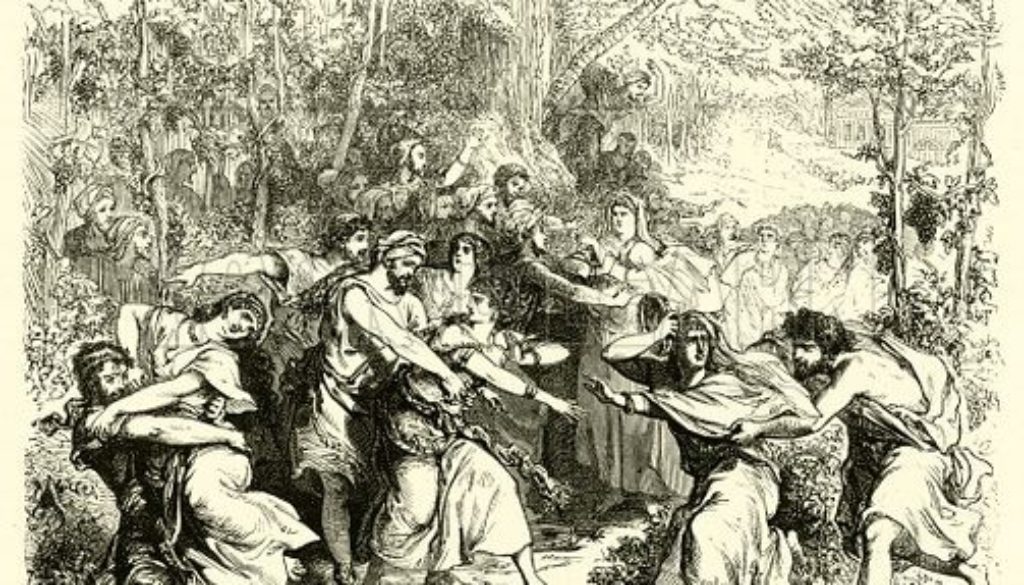
Still sticking to their stupid oath, Israel must find another way to provide wives for the remaining Benjamites. This leads to the most insidious case of hypocrisy and religious legalism we will probably find anywhere in the Bible! Basically, the tribe of Benjamin is given permission to go and kidnap the young women of Shiloh. Any complaints from the families are easily dealt with as: “When their fathers or their brothers come to complain to us, we will say to them, ‘Grant them graciously to us, because we did not take for each man of them his wife in battle, neither did you give them to them, else you would now be guilty” (v22). It’s a case of “it’s all in a good cause and we’re doing it with a thoroughly religious mindset. So you better comply or you’ll be guilty of breaking the vow we’ve made!” At no point is the Lord consulted. Why? Because religion is always driven by man (vs16-22).

So how does it all end? The extraordinary thing is in someways it ends quite well as we are told: ‘And the people of Benjamin did so and took their wives, according to their number, from the dancers whom they carried off. Then they went and returned to their inheritance and rebuilt the towns and lived in them. And the people of Israel departed from there at that time, every man to his tribe and family, and they went out from there every man to his inheritance’ (vs23-24). Despite the kidnapping of a large  number of young women, incidentally breaking a number of God’s laws, everything, that the Lord has promised to them, they still have. Maybe this tells us something, God’s people may not be consistent, but he is!

The Book concludes on an ominous note: ‘In those days there was no king in Israel. Everyone did what was right in his own eyes’ (v25). In the end, the roller coaster ride through Judges  proves one thing, man made solutions are imperfect! Human leaders can be good, but eventually they’ll die, They can start well, but end badly. They can make stupid decisions and they can be thoroughly bad! In the end they are not the solution. Psalm 146:3-4 warns us : ‘Put not your trust in princes, in a son of man, in whom there is no salvation. When his breath departs he returns to the earth; on that very day his plans perish’

The book of Judges may end in a mess, but it’s a glorious mess as it tells us that human leaders, however good, are not perfect. In the end we need God’s King, one not corrupted by leadership or death. We need the Lord Jesus Christ!

The Book of Judges: The Danger of a Knee-jerk Reaction: Judges 20

‘And the men of Israel turned back against the people of Benjamin and struck them with the edge of the sword, the city, men and beasts and all that they found. And all the towns that they found they set on fire’ (Judges 20:48).

Some years back I received a letter from the Christian institute. The Home Secretary had decided that Asbo’s were not an effective deterrent to stop re-offending. So the proposition was to introduce a new bill based on people causing annoyance. On this basis someone could see me on the High Street, doing evangelism and could go up to the nearest policeman and say “that guys really annoying me.” Not surprisingly the bill was quickly dropped. The police and magistrates didn’t want it as it was a badly conceived. Any charge would be almost impossible to prove as it was so subjective! But it shows the danger of a knee jerk reaction, which is what we encounter in this chapter of Judges.

After the shocking events of chapter 19, there’s a feeling that something ought to be done about the wickedness of the men of Gibeah. So: ‘all the people of Israel came out, from Dan to Beersheba, including the land of Gilead, and the congregation assembled as one man to the Lord at Mizpah. And the chiefs of all the people, of all the tribes of Israel, presented themselves in the assembly of the people of God, 400,000 men on foot that drew the sword’ (vs1-2). The Levite gets to tell his story, putting himself in the best light by omitting certain unfavorable details (vs4-8). Israel means business, it’s blood is up as they all feel the men of Gibeah must pay for what they have done (vs8-11). But no one is thinking clearly. On the good side, Israel is united and has come before the Lord. The bad side is they haven’t consulted him! Mob justice will get things done, but the question is will they be done in the right way? After all, not all unity is good unity!

But there’s an additional problem, not everybody is on board with this. When the men of Israel approach the tribe of Benjamin, they won’t play ball! Verses 12-17 have a sinister tone to them. The language Israel uses is undiplomatic leading to the Benjamites dismissing it. The tension in the text escalates with its description of the military prowess of the tribe of Benjamin.

But then Israel does something right by inquiring of the Lord. However, they then spoil it by ignoring the Lord’s command that: “Judah shall go up first” (v18) by deciding they will all go altogether. The result is Israel gets a major whipping for their presumption (vs19-22)! It may seem strange that the Lord allows them to go up against the Benjamites again (v23), but the point the text is making is Israel has already made-up its mind and their approach to the Lord is purely to get a spiritual sheen on their actions rather than seek his will in prayer. So, once again, they suffer defeat for the second time on a catastrophic level (vs24-26)!

Finally, Israel does the right thing. ‘Then all the people of Israel, the whole army, went up and came to Bethel and wept. They sat there before the Lord and fasted that day until evening, and offered burnt offerings and peace offerings before the Lord. And the people of Israel enquired of the Lord (for the ark of the covenant of God was there in those days, and Phinehas the son of Eleazar, son of Aaron, ministered before it in those days), saying, “Shall we go out once more to battle against our brothers, the people of Benjamin, or shall we cease?” And the Lord said, “Go up, for tomorrow I will give them into your hand” (vs26-28). This time the attitude is right as they humble themselves, seeking the Lord’s direction, which he now gives them in definite terms.

Two accounts of the battle follow, the second one being more detailed (vs29-48). Israel is victorious as the Benjamites suffer overwhelming defeat. But there’s a small detail we could easily miss. In verse 35 we read: ‘And the Lord defeated Benjamin before Israel, and the people of Israel destroyed 25,100 men of Benjamin that day.’ Israel had been disobedient, but the Lord was still achieving his purpose through them despite this. This spiritual malaise is typified by the mention of Phineas the priest. He’d made such an impression with his zeal for the Lord during the exodus (Numbers 25:6-15), and was commended for it, but he’s strangely silent here making us wonder if he’d  lost the zealousness he showed as a younger man?

In the end, no one comes out of this very well. There’s huge losses on both sides. The thriving tribe of Benjamin is reduced to 600 men! So one can’t help think that the Lord is judging Israel, because Benjamin is harboring those who committed horrendous immoral acts, and Israel is suffering from a major spiritual malaise. This reminds us the church in any day and age can be subject to judgement when they depart from scripture. ‘For it is time for judgement to begin at the household of God; and if it begins with us, what will be the outcome for those who do not obey the gospel of God?’ (1 Peter 4:17).


The Book of Judges: Leadership Needed, Apply Here! Judges 19

‘In those days, when there was no king in Israel, a certain Levite was sojourning in the remote parts of the hill country of Ephraim, who took to himself a concubine from Bethlehem in Judah’ (Judges 19:1).

When my brother had trained for the ministry and was looking for a church, he worked at Co-op depot in Preston. He’d been witnessing to one of the lorry drivers, so he gave him a Bible. By the time the man had reached the end of Genesis, he was shocked by some of what he had read. The danger is we can be so familiar with the Bible we forget how shocking it can be! But be warned! What comes next in Judges registers as some of the most shocking incidents in scripture!

 At was start of chapter 19, we’re introduced to another wandering Levite. That should raise eyebrows as the Levites were required to do certain jobs connected with religious worship. But we then get the now familiar words: ‘In those days, when there was no king in Israel’ (v1). So the picture is that, even early in their history, Israel was in a bad way and lacking leadership. This kicks off a disturbing story that will take us to the end of the book! Verse 1 is supposed to make us feel uneasy. The best definition of: ‘a concubine’ would be a second class wife! She wouldn’t have the full rights of a married woman and children from such a union wouldn’t have any inheritance. So, to misquote Shakespeare’s Hamlet ‘there is something rotten in the state of Israel.’ Our unease increases when the text informs us that she’s unfaithful to him (how is not specified). Four months pass and he decides it’s time for a reconciliation. So he goes to her father’s house to reclaim her and the whole event seems to turn into a party lasting a few days! The conclusion, this Levite seems to have a lot of time on his hands for someone with a specified job to do (vs2-9).

If these events illustrate a breakdown in what God intended for the family, what happens next illustrates a breakdown in society. After deciding not to stay at Jebus (eventually to become known as Jerusalem) the man decides to stay among his kin in Gibeah. Waiting in the town square might seem strange, but that was where you would have gone if you were looking for hospitality as in Arab culture, then and now, to refuse hospitality would be unthinkable! Once again, there should be a feeling of unease when none is forthcoming but it’s an old man, not originally local to the area, who offers them hospitality (vs10-21).

But if all this wasn’t bad enough, we now get a complete breakdown in morality. What happens next (vs22-26) reminds us of events of Genesis 19 when God deemed the cities of Sodom and Gomorrah  to be so wicked that they were fit for judgement. But we should be doubly shocked as this is among God’s people! There’s an ambiguity in the way that the old man reacts to the threat of homosexual rape being committed on his guest as he protests: “No, my brothers, do not act so wickedly; since this man has come into my house, do not do this vile thing” (v23). So, what would happen if the Levite wasn’t his guest? It also gives the impression that this wasn’t an uncommon occurrence! The Levite reaction is also ambiguous as he does nothing when the old man offers his young daughter to be abused and violated. Then he shows no hesitation in forcing his concubine to go out to the mob to be violently abused for hours!

Now let’s think about this. A Levite is someone who’s supposed to be acquainted with the law and spend his time teaching it, not someone who acts in a thoroughly callous and immoral way. It’s a sad thing when Christian leaders don’t set a moral example, but sadly it’s nothing new!

The Levite’s wicked and callous behavior continues as he: ‘rose up in the morning’ and we realized that he’d slept through the whole thing! His disgraceful behavior continues when he’s surprised when he gets no answer from his dead concubine after she’s been exposed to a vicious gang rape, but puts her on his donkey and goes home (vs27-28).

When we think it couldn’t get any worse we get a breakdown in leadership! The Levite’s grizzly delivery of body parts to the twelve tribes not surprisingly gets a reaction (v29). When a disturbing murder been committed, analysts theorize why it’s happened. Was it the perpetrators background, a disturbing influence in the home or peer pressure? We see the same kind of thing here with everyone trying to analyze what’s happened.  ‘And all who saw it said, “Such a thing has never happened or been seen from the day that the people of Israel came up out of the land of Egypt until this day; consider it, take counsel, and speak” (v30). Quite rightly, everyone’s terribly shocked. But, rather than look to the Lord, Israel is basically saying “if anyone can help us understand this, tell us what to do?” No one’s prepared to take charge. It’s really a case of ‘leadership needed, apply here!’

The Book of Judges: Living Outside the Law of the Lord! Judges 18

‘In those days there was no king in Israel. And in those days the tribe of the people of Dan was seeking for itself an inheritance to dwell in, for until then no inheritance among the tribes of Israel had fallen to them’ (Judges 18:1).

If repetition is a great help when it comes to learning, I don’t think you’d get too much of an argument from the writer of the book of Judges as that’s the technique he applies. In verse 1 of chapter 18 he reminds us that there’s no king, highlighting that the people of Israel are doing their own thing. That being the case, we are now introduced to the Danites who are wandering about and looking for a place to settle down.

However, this should strike us as all wrong. Hadn’t they been granted an inheritance back in the days of Joshua? The answer is yes, but in Judges 1:34 the text tells us that when they went to claim it, the Amorites put up stiff resistance and the Danites had given up on it as a ‘bad job’! So here they are, a few years later (the historical setting being early in the book’s narrative), and they’re still looking for somewhere to settle! Unfortunately, this introduction to the Danites also introduces us to their considerable failings, one of which is covetousness, as they are seeking to take another tribes land by force. So, once again, this demonstrates failure on the part of God’s people.One night five Danites turn up at Micah’s residence. While they’re staying there, they recognise the Levite’s voice. Not unreasonably they ask him what he’s doing there and he gives the explanation that he’s got a cushy job as a priest. So, they ask him to inquire of the Lord for them, will their journey to seek for a place to settle be successful? The priest pretty much tells them what they’d like to hear: “Go in peace. The journey on which you go is under the eye of the Lord” (v6). But, once again, everything about this is wrong as they had already been granted an inheritance, but they had failed to take it (vs1-6)!

Encouraged by this news, however dubious, the Danites continue on their way until they come to Laish. Figuring the people that have a good life and, more to the point, are isolated, they report to their fellow kinsmen that the town is an easy target (vs7-10). Having a contingent to 600 men and no doubt buoyed up by the priest’s Danite pleasing message, they figure that a bit of looting and kidnapping will be overlooked by the Almighty or, who knows, even approved of! When the priest asks them what they’re doing, after telling him to keep quiet, they make him an offer that they reckon he won’t refuse. “Come with us and be to us a father and a priest. Is it better for you to be priest to the house of one man, or to be priest to a tribe and clan in Israel?” (v19). The Levite, probably thinking that career advancement had never come so easily, helps them with some looting and makes his escape with them (vs11-20).

The Danites are a long way down the road before Micah, his family and his servants catch up with them. Not surprisingly, Micah’s somewhat put out, but what he says next shows the pathetic nature of his religion! ‘And he said, “You take my gods that I made and the priest, and go away, and what have I left? How then do you ask me, ‘What is the matter with you?’” (v24). Here we have a man who is centring his whole life around what he has created! However, the Danites show they can be just as pathetic, not just in hanging on to the idols, but by being prepared to fight for them! Being outnumbered, Micah decides to call it a day. When it comes down to it, Micah’s theology wasn’t worth standing up for, and the Danites theology  just consisted of idolatry, insulting language and threats! But what are we to expect when people depart from God’s Law (vs21-26)?

The passage ends with the Danites attacking the unexpecting people of Laish and massacring them. The Danites don’t seem to show any sense of regret over the action they have taken as they rebuild the city, calling it Dan, and setting up ‘the carved image for themselves’ (v30). The Levite’s name is revealed to be Jonathan and he and his sons act as priests acting as rival to the worship at the Tabernacle in Shiloh.

Yet, whereas, often the writers of historical texts in the Bible seemed to offer no judgement (although  we should always read these passages with a mind to what God has ordained through his law) here there is an indication of the writer’s stance. His comments in verses 27 and 29 register strong disapproval. ‘And they named the city Dan, after the name of Dan their ancestor, who was born to Israel; but the name of the city was Laish at the first’ (v29).

As these incidents follow on from the events of chapter 17, the writer continues to pose his question, even adding do it. If, when false religion is introduced into a society, it can affect the structure of the home and the family, what does it do to society as a whole if people continue to pursue it?

The Book of Judges: Setting the Scene: Judges 17

‘And the man Micah had a shrine, and he made an ephod and household gods, and ordained one of his sons, who became his priest. In those days there was no king in Israel. Everyone did what was right in his own eyes’ (Judges 17:5-6).

The closing chapters of the book of Judges (chapters 17-21) could pose a problem that would lead to us scratch our heads in disbelief. What are we to make of them as they don’t seem to follow the pattern of the book, but seem to go off at a tangent? If  1:1-3:6 acted as a historical introduction and  3: 7 -16:31, gave us the case histories of various Judges that the Lord raised up to save his people (with the exception of Abimelech), what are we to make of the final chapters of the book?

Perhaps the best way to think of these chapters is to think of the writer of the book as a bit like a correspondent who’s in the middle of a war zone. They can report on various battles, but they can’t be everywhere at once. So, you get are reports of various incidents that act as  examples of what is happening overall. It’s not the whole picture, but it gives you a good idea of what’s going on.

Every indication is that the events of chapter 17 happened quite early in the history of the book as Phineas (20:28) is the high priest during the time that is covered in these last chapters. He dates from Moses time where he is commended for his zeal for the Lord (Numbers 23:10-13).

But despite this, the opening of the passage might strike us as downright peculiar (vs1-3). We are introduced to Micah who lived in: ‘hill country of Ephraim’ (v1) and who had stolen a considerable amount of money from his mother. However, he very quickly returns it, not because he’s suffering  pangs of conscience, but because he hears his mother uttering a curse concerning it. The peculiarity of the passage really kicks in with his mother’s reply when he returns the money. ‘And his mother said, “Blessed be my son by the Lord” (v2). This is pretty indulgent, and lacking in the discipline his action should’ve demand. But, if the mother’s next words  “I dedicate the silver to the Lord” (v3) seem a bit more encouraging, that rapidly dissipates due to the fact that she doesn’t dedicate all the money, but only a small part of it, and that’s used to make an idol! This  action  breaks a good number of the Ten Commandments. But Micah’s happy to goes along with this and adds it to his collection of idols! He then installs one of his own sons as a priest, showing a major disregard for the law! The text gives a very succinct summing up of these events with the words: ‘In those days there was no king in Israel. Everyone did what was right in his own eyes’ (v6). The writer’s intention in verses 1-6 is very clear, this incident shows that Israel is in a mess, because there are spiritual failings, which inevitably lead to moral failings in the home and family which, being the bedrock of the society, spells big trouble for the nation as a whole!

Next we are introduced to the wandering Levite from Bethlehem (vs7-8). Once again, this should set alarm bells off as there’s so much wrong with this. Firstly, Bethlehem was not one of the towns set aside for the Levites. Secondly, the Levites had jobs connected with the Tabernacle and with the teaching of the Law. And finally, they were supposed to be supported by the people so they could get on with the Lord’s work. But here we have a Levite for hire! He’s not where he should be with time on his hands, wandering around and looking for a place to stay! Let’s face it, this tells us that Israel has fallen into a sorry spiritual state!

However, Micah thinks it will give his shrine added credibility to have a genuine Levite as a priest rather than his son, who should never have been a priest in the first place. The Levite obviously thinks that: ‘ten pieces of silver’ plus clothing (no doubt a priestly garment) and food and lodging sounds a pretty good deal (v10). With his son given the boot as priest and the Levite installed as his new priest, Micah reflects: “Now I know that the Lord will prosper me, because I have a Levite as priest” (v13), happily fooling himself that his false religion will bring him greater prosperity!

The writers intention in this chapter is to show us the low moral and spiritual temperature of the nation. This will prepare us for what we now encounter as we read these last chapters of the book. But it could be argued the writer  is posing a question to prepare us for what will follow. The question is the following, if this is what happens when people get spiritually creative in their worship and ignore what the Lord has commanded, what kind of effect does it have on the nation and God’s people as a whole? The chapters that follow will answer the question!

The Book of Judges: Samson Part 5: Personal or Sacrificial? Judges 16:23-31

Then Samson called to the Lord and said, “O Lord God, please remember me and please strengthen me only this once, O God, that I may be avenged on the Philistines for my two eyes” (Judges 16:28).

If we’ve learned anything about Samson, it’s he always thought he could get himself out of trouble. There’s some debate over how we understand his strength, but I think the text suggests he was naturally strong, but was given exceptional strength when the: ‘Spirit of the Lord’ came upon him. But perhaps that’s part of his problem, he depended too much on his natural gifts and played fast and loose with the Lord’s blessing, always depending on the visible part of the Nazirite vow, his hair, as proof God was with him!

Hollywood excels in films where there’s some form of redemption. A flawed character may commit a sacrificial act, towards the end of a film that makes us want to forgive anything of a dubious nature they’ve done. So, when we come to this point in Samson’s story, many commentators are looking for some form of redemption. But can we actually find it?Verses 23-24 point to the folly of the ungodly. Back in verse 20 we read that the: ‘He (Samson) did not know that the Lord had left him.’ But the Philistines make a tremendous mistake because they believe: ‘Our god has given Samson our enemy into our hand’ (v24). Their second mistake is they didn’t realize Samson was an instrument of the Lord, who was using him to punish the Philistines for their oppression of his people. So, in their mind’s, it’s obviously a time for celebration and, while they’re thinking about it, wouldn’t it be a good idea to have Samson, who they see as blinded and harmless, come out and entertain them (v25)!

But the way this temple was constructed gave Samson an opportunity. Excavations in the Near East have showed that the supports of these temples would have been huge wooden pillars which were on a stone base, but were held in place by the weight of the roof. Samson, on his trips to Gaza, may have noticed this. Under the guise of wanting some rest, he asks the young man leading him to place his hands on these pillars (v25-28). No doubt, Samson had had plenty of time to think about his Nazirite vow. So what happens next suggests that he’s realized his long hair is not the source of his strength, but the outward sign of God’s blessing and this is what now shapes the prayer he now prays.

But what he prays needs to be carefully analyzed. Is this a prayer of faith, that seeks to do the Lord’s will, and glorify him? Or is it possible, that this prayer has elements which relate to Samson’s condition and a thirst for revenge?

Samson had prayed to the Lord before (15:18). But as that was after the: ‘Spirit of the Lord’ had come upon him, you  get the impression they’re prayed in the spirit of ‘I’ve done your work, so you now owe me.’ But this prayer is before he does anything. So, this is a much more positive spiritual attitude than we’ve seen from him before. So let’s look at the content of his prayer.

Samson uses two names for the Lord here. But the first, and most important use is ‘Yahweh,’ as he addresses him as: ‘LORD God’ (v28). This suggests that for the first time Samson is actually acknowledging that the Lord has been working through him and it’s the Lord who has authority over him, whereas up to this point, Samson has seemed to do his own thing!

But, as soon as he’s done that, it’s payback time! Samson seeks revenge for being blinded. So, the question is, have we gone from an acknowledgment that he has been used and guided by God in the past, whether he realized it or not, to good old fashioned revenge on the level of any Hollywood action movie with the tag line ‘This time it’s personal!’ Yet, at the same time, his action takes on a sacrificial act with his words: ‘let me die with the Philistines’ (v30) as he wins a huge victory for Israel by practically taken out the Philistine high command in one go!

The story comes to an end with his family coming and taking the his body for burial with no resistance, which is not surprising after the defeat the Philistines have just suffered. We are reminded that: ‘He judged Israel for 20 years’ (v31). But, and it’s a big but, Samson leaves us with many questions  when it comes to trying to evaluate him.

On one hand we have someone who’s birth was foretold, who was dedicated to the Lord and gifted in a most unique way. He carries out the Lord’s purposes and his life ends in an almost a sacrificial act. Yet, most of the time he’s a loner, and the maverick Judge of Israel! He begins the deliverance of Israel, but it’s the Lord who will finish it! Some commentators have labelled Samson  a ‘type’ Of Christ’. I would say that he’s more of an impression of the work of Christ, as there are interesting parallels.

Dale Ralph Davis tells the story of how a delegation went to President Abraham Lincoln during the American Civil War calling for the sacking of General Ulysses Grant, who, reportedly, had been drunk at the battle of Shiloh. Apparently, Lincoln sat in silence for a long time. Eventually, he said: “I can’t spare this man; he fights.”[1] Perhaps that’s the best way to sum Samson up. Put him with Israel’s (and therefore God’s) enemies and there’s bound to be fireworks. We may not always understand how God’s sovereignty works, but we can take immense comfort from the fact it does!

[1] Dale Ralph Davis, Judges, Such a Great Salvation (Fearn, Christian Focus, 2000) 193.